
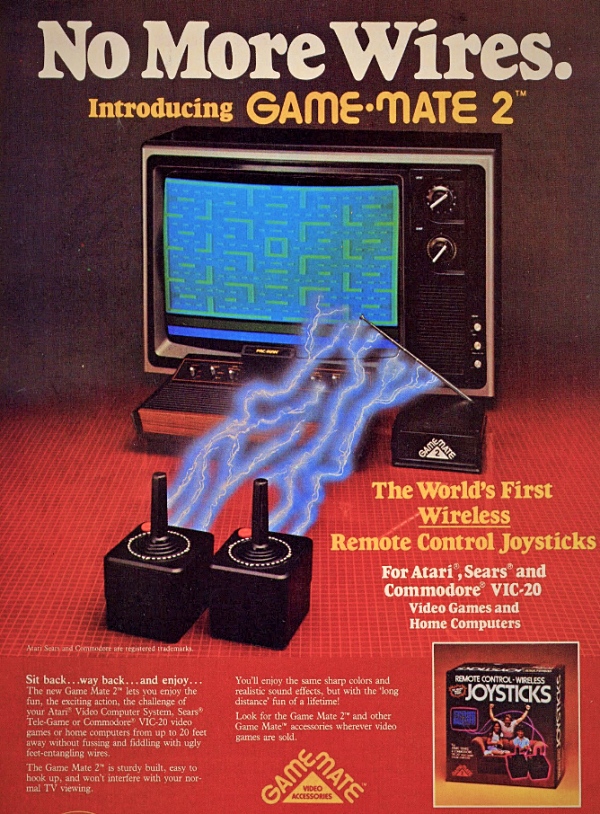
The history of wireless controllers, now standard equipment for game consoles, goes back about 40 years.
On Oct. 7, local time, IT outlet Engadget reported that a representative early example of wireless game controllers is Cynex's Game Mate2, which appeared around 1982. It could be used with the Atari 2600 and other systems, and is regarded as one of the first console-compatible wireless controllers.
Game Mate2 used radio frequency rather than infrared. It did not need to be pointed directly at the receiver on the console and worked from about 20 feet, or about 6 metres, away. It was bigger and heavier than existing Atari joysticks and each used a 9-volt battery. Atari later distributed it and sold it under the name CX42 Remote Control Wireless Joystick.
A turning point in the popularisation of wireless pads came with Nintendo's WaveBird for the GameCube in 2002. Using 2.4 GHz wireless technology and a separate receiver, it could be used from at least about 20 feet away. It dropped vibration but could run for up to 100 hours on 2 AA batteries, easing what was then the biggest weakness of wireless controllers: battery problems.
Sony's full-fledged introduction of a wireless controller to PlayStation began with the PS3 Sixaxis in 2006. It removed vibration while emphasising motion sensors. Phil Harrison (필 해리슨), then president of Sony Computer Entertainment Worldwide Studios, described vibration as a feature from the previous generation.
But as motion-control-focused titles such as Lair received poor reviews, complaints about the lack of vibration grew. Sony eventually released the DualShock 3 in 2008, restoring vibration. Missteps in early wireless controllers thus led to modern gamepads that combine battery life, vibration and stable wireless connections.
 Choi Jae-won
ittt_0801@d-today.co.kr
Choi Jae-won
ittt_0801@d-today.co.kr