
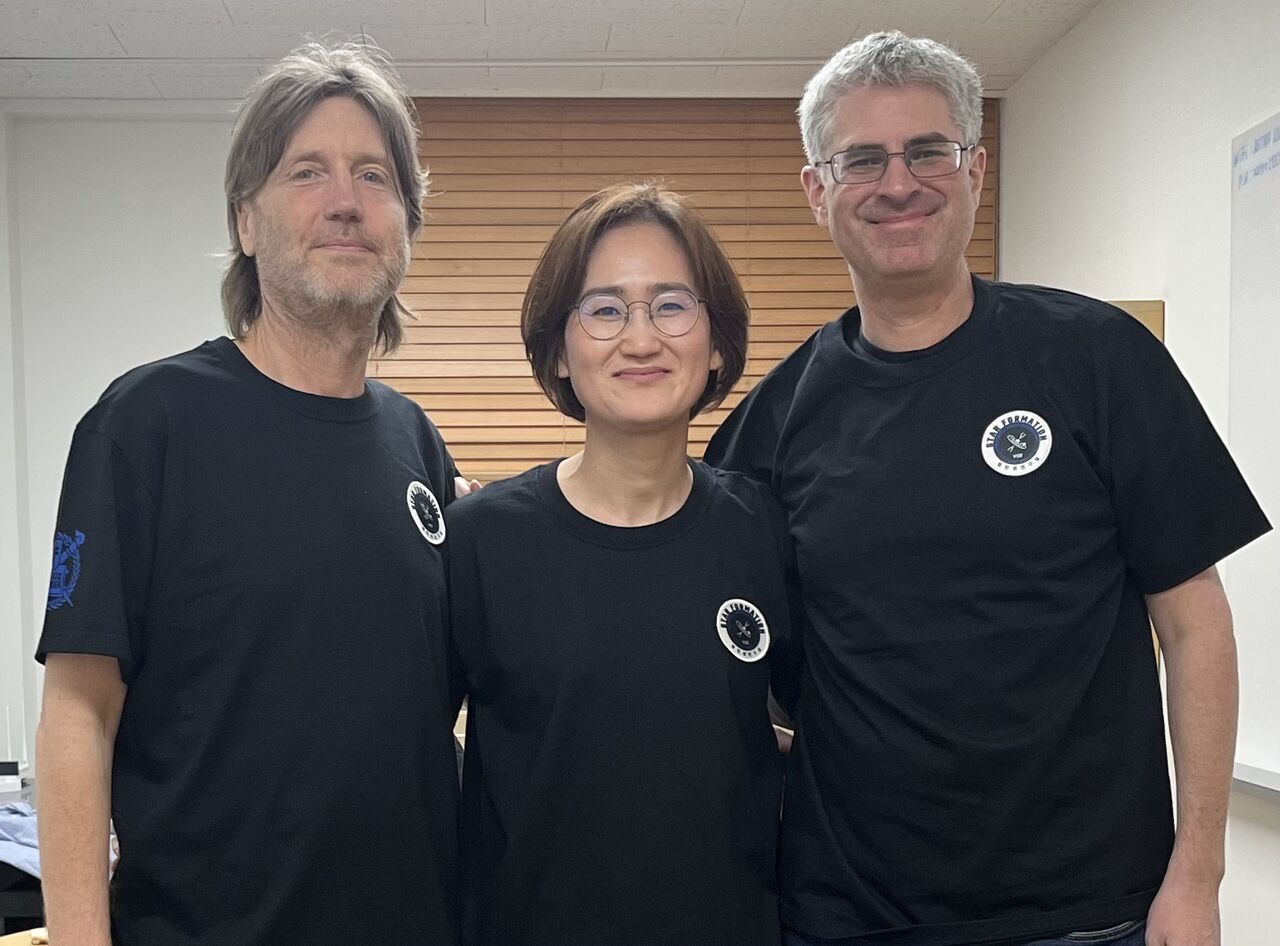
South Korea's Ministry of Science and ICT and the National Research Foundation of Korea said on Tuesday they selected Lee Jeong-eun (이정은), a professor in the Department of Physics and Astronomy at Seoul National University, as the October winner of the Korea Science and Technology Award.
The award selects 1 researcher each month who has produced original research achievements over the past 3 years and contributed to advances in science and technology. It confers the ministry's deputy prime minister's prize and 10 million won in prize money.
Lee was recognised for results that identified how crystalline silicates, materials that make up planets, are created and move during the formation of protostars.
The research team applied a time-domain spectroscopic observation method that observes before and after outbursts for the protostar EC 53, whose brightness varies on a cycle of about 1.5 years.
Using the U.S. National Aeronautics and Space Administration's James Webb Space Telescope (JWST), the team directly observed for the first time in the world crystalline silicates newly forming during an intermittent accretion outburst, when mass infall surges.
The team also combined JWST data with observations from the Atacama Large Millimeter/submillimeter Array (ALMA) radio telescope. It identified how crystals formed at high temperatures move on a disk wind to a cold region where comets form.
The findings show a possibility that a similar process occurred in the early solar system about 4.6 billion years ago. They provided clues to understanding the origin and evolution of the constituent materials of planets, including Earth. The research was published in the international journal Nature in January.
Lee said, "It is deeply meaningful that an international study led by Korean researchers has uncovered the full picture of early solar system material changes, a long-standing challenge in astronomy." She added, "I want to continue studying how the materials of stars and planets, and further, the ingredients of life, are born and linked in the universe."
 Son Seul-gi
sageson@d-today.co.kr
Son Seul-gi
sageson@d-today.co.kr