
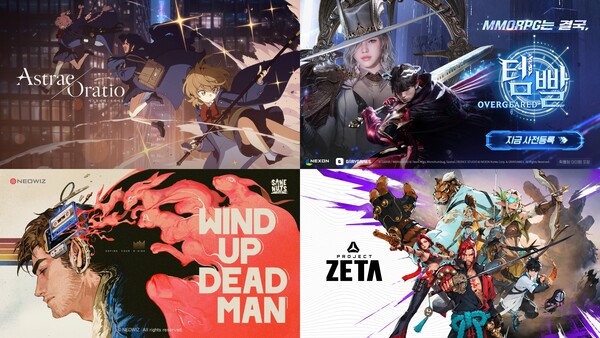
Major South Korean game companies are strengthening their publishing businesses by discovering and servicing games made by outside developers alongside in-house development.
With development of big-budget new titles taking longer, companies are moving to broaden sources of new releases by securing external games and intellectual property (IP) rather than relying on a few internally developed titles. Another aim appears to be to share roles with specialist studios to supplement release cycles and genres, as it is difficult for one company to maintain development teams across many genres.
The industry is seeing changes in how major game companies are building their new-title lineups, the sector said on Tuesday. NCSoft has secured more than 10 in-house titles and more than six publishing titles. Nexon has also been expanding its domestic publishing lineup of externally developed games one after another in the second half of this year. Krafton and Neowiz are also pursuing both in-house development and external publishing to broaden their sources of new titles.
NCSoft is making active use of outside developers as it expands a lineup previously centered on massively multiplayer online role-playing games (MMORPG) into subculture and shooting genres.
It is publishing "Limit Zero Breakers" developed by Big Game Studio and "Astrae Oratio" by Dynamis One. It also secured global publishing rights to "Defect", a shooting game under development by U.S. studio Emptyvessel. It invested directly in Dynamis One and Emptyvessel.
NCSoft is broadening its lineup by investing in developers with experience in those genres or securing publishing rights. It is pursuing a strategy of securing new IP and diversifying genres by expanding both in-house development and publishing.
Nexon is also adding external games to its in-house slate. After starting domestic service for Bilibili-developed "Higan: Eruthyll" in July and Blizzard Entertainment's "Overwatch" in August, it began pre-registration on Oct. 1 for "The Greatest Estate Developer: Overgeared", an MMORPG under development by Graygames. It also handles domestic publishing for the open-world RPG "Azur Promilia" under development by China's Manju Games.
Nexon is also pursuing a strategy of widening sources of new titles and broadening genres by running in-house development and publishing in parallel.
SHORTENING RELEASE GAPS AND BROADENING GENRES
The background to game companies expanding publishing lies in changes in how new titles are developed.
Big-budget new titles often take years to develop. If a launch is delayed or a project is halted, the gap until the next new title can grow long. If a game that finally launches fails to deliver the expected results, the burden of costs poured in over a long period also increases.
The more a company relies on only a few in-house titles, the greater the impact the success or failure of a specific project can have on the entire lineup and performance.
Securing externally developed titles as well can increase sources of new titles separately from internal project schedules, and can allow faster entry into genres where in-house experience is limited.
Krafton is collaborating not only with in-house and subsidiary studios but also with outside developers to secure new IP to follow "PUBG: Battlegrounds". At Gamescom 2026, it also presented new titles from external developers such as "Project Zeta", "Age Twister" and "Tarae: Unbound" as part of its publishing lineup.
Neowiz is also preparing five in-house titles and three publishing titles. It is continuing to develop its own IP while adding games from outside developers such as WolfEye Studios, Zakazane and Zainnuts to broaden its pipeline of new titles.
Securing new genres is also a reason for expanding publishing. For a company that has mainly developed MMORPGs to make subculture or shooting games in-house, it needs to newly secure relevant personnel and development experience. Working with developers that have experience in those genres allows a division of roles, with the developer focusing on production and the large game company providing funding and service capabilities.
As a result, the recent expansion of publishing is closer to a portfolio strategy of spreading risk across multiple projects than simply filling a shortfall in the number of new titles. That is because it can lower reliance on the schedule or performance of a single in-house title while using external projects to complement genres and release timing.
FROM 'MAKING WELL' TO 'CHOOSING WELL'
The role of publishing is also no longer limited to simple distribution. Its scope of involvement is expanding, from early-stage investment and securing rights to localization, global marketing, platform distribution and live service after launch.
It is not enough to find a good game and sign a contract. Deciding which regions and platforms to launch on and securing users to translate into actual performance has also become part of a publisher's role.
Game companies' competitiveness is also changing accordingly. Not only how many games they can make themselves but also the ability to find promising developers and projects first, and to turn secured games into results in the global market, is becoming more important.
Still, that does not mean publishing is a safer business than in-house development. Externally developed titles can also be delayed or fail commercially, and companies may not recover investment, contract fees and marketing costs. That is why the ability to judge which projects to choose is as important as securing multiple games.
Ultimately, the expansion of publishing by game companies is closer to broadening ways to secure new titles than replacing in-house development. They develop core IP themselves while using external projects to supplement release cycles and genres.
A sector official said, "As development periods for big-budget games lengthen, it has become difficult to maintain a steady release schedule with only in-house titles." The official added, "Going forward, not only the capability to make games well directly but also publishing capabilities to discover competitive external projects and translate them into results in the global market will be important."
 Ho-jung Lee
lhj@d-today.co.kr
Ho-jung Lee
lhj@d-today.co.kr