
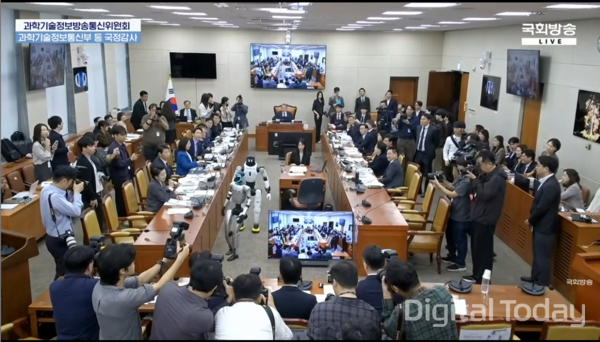
A Chinese-made humanoid robot appeared in person at a National Assembly audit and danced to show its capabilities, while the government pointed to AI software capabilities such as data and robot foundation models (RFM) as key to securing competitiveness in physical AI.
Deputy Prime Minister and Minister of Science and ICT Bae Kyung-hoon (배경훈) said at the Science, ICT, Broadcasting and Communications Committee’s audit of the ministry on Oct. 6, "The core of physical AI is competitiveness in AI and software, such as data and robot foundation models." He added, "We will not miss this part and will build competitiveness."
On the day, Democratic Party lawmaker Lee Jung-heon (이정헌) brought two humanoid robots made by Chinese robot companies Unitree and Azhabot into the audit venue and demonstrated them. Lee cited his recent visit to a humanoid production facility and a robot data learning center in Beijing and pointed to the gap between South Korea and China in the physical AI industry.
According to Lee, China has about 160 companies producing finished humanoids and more than 600 core parts companies. Annual investment in the robot industry is also about 30 billion yuan, or about 6.4 trillion won.
By contrast, of 2,814 domestic AI companies, 53 hardware companies, including humanoid makers, accounted for 1.9 percent. China’s share of humanoid patents was 60.8 percent in the first half of this year among the five major countries, far ahead of South Korea’s 4.6 percent, and patents related to RFM were about 66.3 percent for China and 8.8 percent for South Korea, Lee said.
Reliance on Chinese-made robots in domestic public research sites was also raised. Lee said 36 Chinese-made robots are deployed at science museums under the Ministry of Science and ICT, and that the Korea Institute of Science and Technology (KIST), the Korea Institute of Machinery and Materials (KIMM) and the Electronics and Telecommunications Research Institute (ETRI), among others, are also using Chinese-made humanoids for research.
He also pointed out that the government did not allocate an RFM R&D budget through 2024, but assigned 4 billion won each for last year and this year.
Bae said, "Investment was woefully insufficient in the past," and added, "We plan to step up investment in the physical AI sector in earnest through three mega projects."
He added, "We designated physical AI as South Korea’s future growth engine," and said the government is preparing to build a humanoid and robot ecosystem that can be used in industrial settings, not simply robots that dance.
 Seulgi Son
sageson@d-today.co.kr
Seulgi Son
sageson@d-today.co.kr