
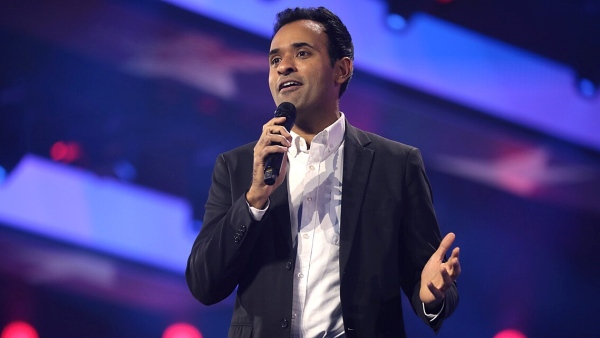
Vivek Ramaswamy is not putting cryptocurrency at the forefront as a key campaign issue in the Ohio governor's race, unlike during his presidential run.
Cointelegraph reported on Oct. 5 that while Ramaswamy holds a stake in a digital asset manager and receives backing from figures in the cryptocurrency industry, related messaging has noticeably decreased in his recent public remarks.
During the 2024 Republican presidential primary, Ramaswamy publicly backed bitcoin and mining and strongly opposed a central bank digital currency (CBDC). He repeatedly delivered pro-cryptocurrency messages in speeches and at industry events. But as of September 2026, that stance appears to have weakened significantly. After Ohio Secretary of State Frank LaRose announced on Sept. 17 that the state would accept cryptocurrency for government fees and service payments, Ramaswamy did not publicly state a position on the issue.
His links to cryptocurrency have not disappeared. Before announcing his run for governor in February 2025, Ramaswamy supported an Ohio strategic cryptocurrency reserve bill. The bill would allow the creation of a state-level bitcoin reserve. Strive, the asset manager he co-founded in 2022, also unveiled plans in September 2025 to enter the bitcoin bond ETF market, focusing on bonds issued by companies that buy bitcoin.
He also remains close to the cryptocurrency industry in terms of funding and interests. Ramaswamy's campaign is accepting cryptocurrency donations. Chase Herro, Zach Folkman and Zachary Witkoff, co-founders of Trump family cryptocurrency firm World Liberty Financial (WLFI), each donated the legal maximum of $16,615. Susquehanna International Group co-founder Jeff Yass gave $20 million to his super PAC, while New York Digital Investment Group (NYDIG) founder Ross Stevens donated $6 million and Elon Musk gave $5 million. The Bitcoin Voter Project also contributed $5,000.
Ramaswamy also has significant exposure to digital assets. Strive reported that as of Aug. 28 it held 23,156 BTC. An August U.S. Securities and Exchange Commission (SEC) filing showed Ramaswamy held 5,693,897 shares in the firm, valued at more than $170 million as of Sept. 26. He also reported that as of April he directly held bitcoin and ether worth more than $1,000 through a Coinbase wallet.
Even so, locally sensitive issues appear to be taking priority over cryptocurrency in campaign strategy. A poll conducted by Digital Currency Group (DCG) in May 2024 found Ohio voters were more negative about cryptocurrency than those in other states. Some 79 percent said they had never owned cryptocurrency, and 77 percent expressed a negative view of digital currencies. The poll described Ohio voters as being "more negative" about cryptocurrency.
Data centre issues have also emerged as a major issue in the governor's race. The Pew Research Center said as of April Ohio had 166 data centres, the highest level in the United States. Several cryptocurrency miners, including Cipher Mining, Bitdeer and BIT Mining, are also based in the state. Polling also found many residents do not support building data centres in their communities.
Ramaswamy promised in August to ensure residents would not face higher electricity bills if data centres move into Ohio communities and said he would lower property taxes as well. By contrast, Democratic candidate Amy Acton said, "Costs for gas, water and electricity should be borne by data centres and investors, not Ohio taxpayers or communities." That has made electricity and local cost burdens a more direct election issue than cryptocurrency.
The race is also tight. As of Sept. 22, Acton led Ramaswamy by 1 percentage point in the RealClearPolling average. More than $2 million was wagered on Kalshi prediction market contracts, which reflected a 66 percent chance of a Democratic victory. Polymarket showed a similar trend.
In this situation, Ramaswamy has not abandoned his pro-cryptocurrency stance, but the priority of his late-campaign messaging appears to have shifted. While industry funding and investment exposure remain, bread-and-butter issues such as data centres and local cost burdens are emerging as a bigger factor for voters than cryptocurrency.
 Jinju Hong
hongjj@d-today.co.kr
Jinju Hong
hongjj@d-today.co.kr