
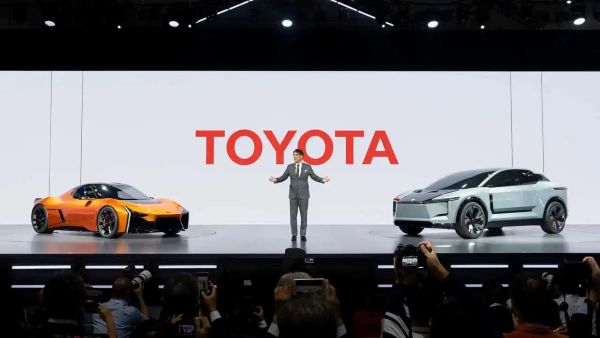
Toyota has kept a hybrid-led electrification strategy in the U.S. market, while an assessment by a company executive has emerged on its response to the EV market and the competitiveness of its early products.
On Sept. 28, EV-focused outlet InsideEVs reported that Cooper Ericksen (Cooper Ericksen), senior vice president in charge of Toyota North America’s product, battery electric vehicle and mobility planning and strategy, described responding to the EV market as a “roller-coaster journey in many ways.”
Toyota has continued a hybrid-led electrification strategy while moving relatively slowly in shifting to fully electric vehicles. It has switched the 2026 RAV4 to a hybrid-only model, and it is selling only hybrid versions of the Camry. Toyota said electrified vehicles account for half of its U.S. sales and most of those are conventional hybrids.
Ericksen said gauging market demand is the starting point for the company’s strategy. “We follow customers,” he said, drawing a line against the view that all consumers currently want battery electric vehicles.
EV sales have risen in recent years, but Ericksen argued that government and automaker incentives had a major impact. He said some automakers at the time offered incentives of $10,000 to $20,000 per EV, with an additional $7,500 in support from the federal government. He claimed that overall, manufacturer and government incentives worth $20,000 to $30,000 were applied to a significant number of EV sales.
“You shouldn’t look at true customer demand through that lens,” Ericksen said. He added that offering a $30,000 incentive on the RAV4, which sells about 450,000 units a year, would significantly boost sales. Citing that EV market penetration peaked at 9 percent, he argued that consumer demand to buy EVs at a profitable price point remains limited.
Based on that view, Toyota is maintaining a “multi-pathway” strategy that pursues hybrids, EVs and hydrogen together. It says it has kept its existing strategy even as rivals adjust their EV plans after related U.S. regulations were eased. “We’re sticking to the strategy, and we’re happy because it’s working well,” Ericksen said. “The biggest winner right now is the hybrid powertrain,” he said.
Toyota acknowledged, however, that its early EV products lacked competitiveness. Its first mass-market EV, the bZ4X, was assessed as lacking competitiveness in driving range, charging performance and EV-specific features. Ericksen also said, “The first bZ didn’t have the product competitiveness we wanted,” adding that the criticism at the time was not wrong.
Toyota said it learned about the characteristics of EV buyers during the process. It said the group of consumers ready to accept a full shift to EVs is not yet large, but they have strong preferences for EVs and place a high value on fuel-cost savings. Toyota has continued to improve its products, reinforcing driving range, charging speed and software in the new bZ.
Toyota has launched the new C-HR and bZ Woodland EVs, an improved bZ and the Lexus ES EV, and it plans to introduce the Toyota Highlander and Lexus TZ, three-row electric SUVs. Ericksen said these large SUVs would create “another plateau” for Toyota’s EV business.
Toyota’s outlook for expanding EVs is more conservative than that of rivals. Ericksen mentioned the possibility that battery EVs could make up 7 to 10 percent of Toyota’s total in 2030, roughly around 10 percent.
Toyota is keeping its hybrid-led strategy while expanding its EV lineup. Over the long term, it still faces the task of proving product competitiveness as it must compete with EVs from emerging EV makers, Chinese automakers and established automakers.
 Seung-a Yoo
ysah@d-today.co.kr
Seung-a Yoo
ysah@d-today.co.kr