
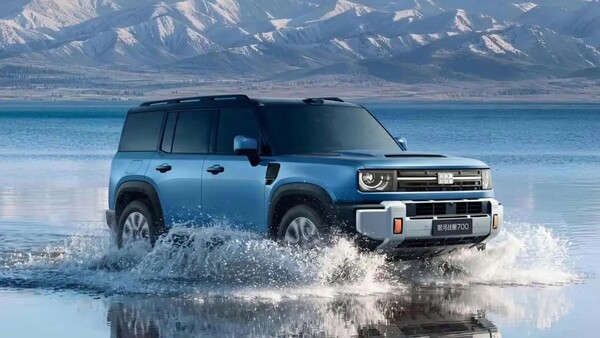
[DigitalToday reporter Jinju Hong (홍진주)] China automaker Geely has unveiled a large SUV that can move on its own with propellers when it falls into water. It is not simply an amphibious leisure vehicle. It features an emergency function aimed at helping occupants escape when the vehicle is flooded.
InsideEVs, an electric-vehicle outlet, reported on Sept. 21 local time that Geely has started sales in China of the large SUV, the Battleship 700. The vehicle has an emergency flotation and escape mode equipped with 2 dedicated propellers at the rear.
The most striking feature of the Battleship 700 is the two propellers at the rear of the vehicle. Each produces about 11.5 horsepower. They normally look like exhaust outlets, but work as propulsion devices when the vehicle enters water.
Geely describes the function not as a leisure feature for crossing lakes or rivers, but as a survival device for occupants to get out safely in emergencies such as flooding. The vehicle can move on water at a speed slightly above 4 miles per hour.
It also has sonar to support water travel. It detects underwater obstacles to reduce collision risks. Water travel is time-limited, however. The Battleship 700 can move on water for about 40 minutes, and can stay afloat with the engine off for up to 2 hours.
Geely presents the water-travel time and simple floating time separately. That means floating on water and actually moving using the propellers are different functions.
The appearance of an SUV with water-travel capability in China's EV market is not a first. BYD's premium SUV Yangwang U8, for example, also has an emergency flotation function.
The propulsion method differs, however. While the Yangwang U8 gains thrust on water by rotating its wheels, the Battleship 700 has separate propellers at the rear. InsideEVs explained that while the Yangwang U8 travels on water at around 2 miles per hour, the Battleship 700 can move faster on water through its dedicated propulsion system.
On land, it operates as a high-performance plug-in hybrid SUV. The Battleship 700 combines a 2.0-liter turbo engine with 3 electric motors. One motor is placed on the front axle and 2 on the rear, with combined system output reaching 1,113 horsepower.
Battery capacity is 47.14 kWh. Under China's CLTC standard, range using both the engine and battery is given as up to 1,100 miles.
Pricing in China starts from just under $30,000 (about 40.78 million won), rising to about $58,000 (about 78.85 million won) for higher specifications. Sales have begun in China, and Geely is also pushing to enter overseas markets including Australia.
The Battleship 700's specialized features are not limited to water travel. It also has an oxygen supply system for high-altitude driving. Geely explained it was designed to supply oxygen via a mask or inside the cabin.
This feature set shows that the competition among Chinese automakers to differentiate is expanding beyond convenience features to vehicle safety and survivability. It is widening the scope of how vehicles respond to extreme environments such as flooding and high altitudes, beyond existing differentiators such as refrigerators, AI assistants and large displays.
In particular, the Battleship 700 differs from existing SUVs in that it does more than simply float when it falls into water, securing an escape route with separate propellers. Still, because water travel is an emergency function used for a limited time, it is not intended to be used like a typical amphibious vehicle.
Ultimately, the Geely Battleship 700 is an unusual model that adds water escape and oxygen supply to a 1,113-horsepower (about 830 kW) high-performance SUV. It is a notable example of how Chinese automakers are expanding cars beyond simple transportation into survival platforms that protect occupants even in extreme situations.
 Jinju Hong
hongjj@d-today.co.kr
Jinju Hong
hongjj@d-today.co.kr